
LLM Reference
LLM Reference helps tech leaders quickly find and compare the best AI models and providers for their specific project needs.
Visit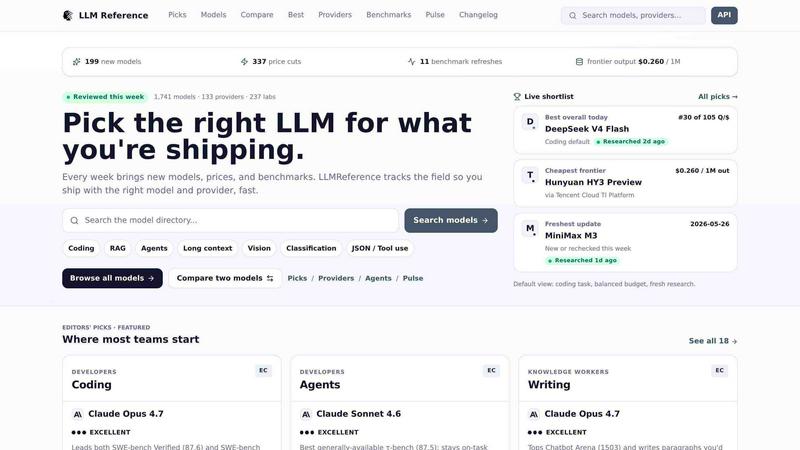
About LLM Reference
LLM Reference is a comprehensive decision-support directory designed specifically for engineers and technology leaders who need to navigate the rapidly expanding landscape of large language models (LLMs) and their providers. In an ecosystem that now tracks over 1,843 language models from 140 providers and 247 research labs, finding the right model for a specific task can be overwhelming. LLM Reference eliminates this friction by serving as a single, trustworthy source of truth. The platform tracks every major model release, price change, and benchmark update, refreshing its data weekly to ensure users always have access to the most current information. Its core value proposition is straightforward: stop wasting time hunting through scattered sources and start shipping with confidence. Whether you are building a coding assistant, an agentic workflow, a writing tool, or a research pipeline, LLM Reference gives you the tools to compare models side-by-side, identify the cheapest frontier output pricing, and browse curated editors picks for specific tasks such as coding, agents, writing, research, image generation, and video creation. The site is built for fast triage, allowing users to quickly identify the right model for their job, determine the most cost-effective provider, and get back to building. With a Pulse feed that highlights weekly changes including new models, price cuts, and benchmark refreshes, LLM Reference keeps you informed without the noise. It is built by the Data Advantage project and updated daily, making it an essential resource for anyone who needs to stay current with the exploding LLM ecosystem.
Features of LLM Reference
Comprehensive Model and Provider Directory
LLM Reference maintains an exhaustive directory of over 1,843 language models sourced from 140 providers and 247 research labs. Each model entry includes detailed metadata such as provider information, pricing per million tokens, benchmark scores across major evaluation suites, and release dates. This directory is refreshed weekly to incorporate new releases, verified price changes, and updated benchmark results, ensuring users always have access to the most accurate and current data for their decision-making.
Side-by-Side Model Comparison
The platform offers a powerful comparison tool that allows users to evaluate two models directly against each other. This feature displays key metrics such as pricing, benchmark performance, context window size, and supported tasks in a clean, side-by-side format. Users can quickly see which model offers better value for their specific use case, whether they prioritize raw performance, cost efficiency, or a balance of both, enabling informed decisions without manual research.
Curated Editors Picks and Leaderboards
LLM Reference features expert-curated editors picks organized by audience and task. Developers can find top recommendations for coding, agents, tool use, open weights, long context, and cheap models. Knowledge workers get picks for writing, research, summarization, docs Q&A, translation, and data and SQL. Creatives find selections for image, video, voice, transcription, music, and image editing. Each pick includes a rationale explaining why the model excels for that task, along with benchmark evidence and pricing context.
Pulse Feed for Weekly Market Changes
The Pulse feed provides a weekly summary of what changed in the model market, including new model releases, verified provider price cuts, and benchmark refreshes. This feature highlights the most significant updates, such as the addition of 177 new models, 53 price cuts, and 368 benchmark refreshes in a single week. Users can quickly scan this feed to stay informed about the latest developments without being overwhelmed by the constant noise of the AI landscape.
Use Cases of LLM Reference
Selecting a Coding Assistant Model
Engineering teams building coding assistants or agentic workflows can use LLM Reference to identify the best performing models for software development tasks. The platform highlights models like Claude Fable 5, which achieves 80.3 percent on SWE-bench Pro and 96 percent on SWE-bench Verified, making it a top pick for non-trivial engineering tasks. Users can compare coding-specific benchmarks, pricing, and context windows to choose the model that best fits their development environment and budget.
Choosing a Cost-Effective Provider for Production
Technology leaders responsible for managing AI infrastructure costs can leverage LLM Reference to find the cheapest frontier output pricing. The platform tracks verified price cuts from providers and displays the lowest cost per million output tokens. For example, Hunyuan HY3 Preview via Tencent Cloud TI Platform offers frontier output at just 0.260 dollars per 1M tokens, allowing teams to deploy high-quality models while controlling operational expenses.
Evaluating Models for Research and Knowledge Work
Researchers and knowledge workers can use LLM Reference to select models optimized for analytical tasks such as summarization, translation, and data querying. The platform provides leaderboards showing top performers for research, writing, and document Q&A. Claude Fable 5 is highlighted for its strong performance on GDPval-AA ELO 1932 and finance-related analytics, while Gemini 3 Pro excels at tool use and long context tasks, helping users match model strengths to their specific research workflows.
Comparing Models for Creative Content Generation
Creative professionals working on image generation, video production, or music composition can use LLM Reference to find the best models for their medium. The platform curates editors picks for creatives, such as FLUX.2 Dev for photorealistic image generation with brand consistency and Veo 3.1 for high-quality video output up to 4K resolution. Users can compare model capabilities, output quality, and pricing to select the right creative tool for their projects.
Frequently Asked Questions
How often is the data in LLM Reference updated?
The data in LLM Reference is refreshed weekly to include new model releases, verified price changes, and benchmark updates. The platform tracks over 1,843 language models from 140 providers and 247 research labs, with a dedicated Pulse feed that highlights the most significant changes each week, such as new models, price cuts, and benchmark refreshes. Users can rely on the platform for current and accurate information.
How does LLM Reference determine its editors picks?
Editors picks are curated by the LLM Reference team based on a combination of benchmark performance, real-world task suitability, pricing efficiency, and community feedback. Each pick includes a detailed rationale explaining why the model excels for a specific task, such as coding, agents, writing, or image generation. The picks are regularly reviewed and updated as new models and benchmarks become available.
Can I compare specific models against each other?
Yes, LLM Reference includes a dedicated comparison tool that allows users to evaluate two models side-by-side. This feature displays key metrics including pricing per million tokens, benchmark scores across major evaluation suites, context window size, and supported tasks. Users can directly compare models like Claude Fable 5 versus GPT-5.5 or Claude Opus 4.8 versus Claude Opus 4.7 to make informed decisions.
Is LLM Reference free to use?
The provided content does not include specific pricing information for accessing LLM Reference. The platform appears to be a publicly accessible directory and comparison tool. For the most accurate and current information regarding any subscription plans, usage limits, or premium features, users should visit the official LLM Reference website or contact the Data Advantage project directly.
Similar to LLM Reference

Apps and files on an infinite canvas where people and AI agents work together.

AI meeting notes, transcripts, summaries and action items on iPhone, iPad and Android.

Provide AI-powered customer support widget for your website


