
StockFit API
StockFit API delivers clean, standardized financial data from SEC filings, ready for modeling and backtesting.
Visit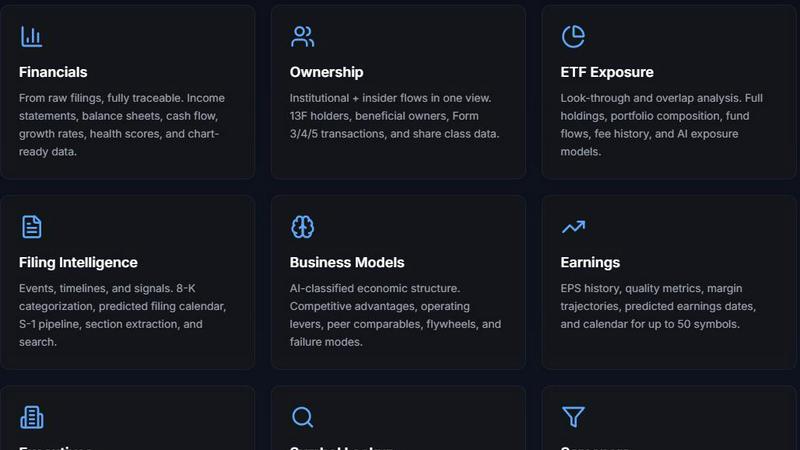
About StockFit API
StockFit API is a specialized financial data platform engineered specifically for developers, quantitative analysts, and research platforms that require direct, reliable, and auditable access to SEC filing data. The fundamental problem StockFit solves is the pervasive trade-off in financial data access: either pay for inexpensive tiers that deliver inaccurate or incomplete data, or commit to expensive enterprise contracts that drain startup budgets. StockFit completely fills this gap by pulling financial data directly from SEC XBRL filings, eliminating any derived middle layer. This means every single number returned by the API is traceable back to its original filing, giving users confidence that their models are built on accurate and auditable information. The platform covers a comprehensive range of data including fundamentals, ownership data, ETF and mutual fund exposure, insider transactions, and all types of filings. StockFit handles complex edge cases that other APIs ignore, such as amended filings, companies with non-December fiscal years, and Q4 reconstructions from 10-K and 10-Q data. Beyond raw numbers, StockFit provides rich economic models per company including offerings, peers, operating levers, competitive advantages, flywheels, strategic initiatives, and failure modes. For ETF and mutual fund exposure, the platform models mandate, portfolio construction, costs, sensitivities, and use cases in an AI-friendly format perfect for LLM workflows. With over 250 million facts, 5 million filings, and daily updates, StockFit is built for serious financial analysis, valuation, and backtesting.
Features of StockFit API
Source-Cited Financial Data
Every financial fact returned by StockFit API is directly sourced from SEC XBRL filings, meaning there is no derived or interpolated data layer. Each data point includes a source reference linking back to the specific filing document, enabling full auditability and traceability. This feature is critical for developers and quants who need to verify data accuracy, build compliant models, or simply understand the provenance of every number they use in their analysis.
Standardized and Model-Ready Outputs
StockFit API delivers financial data in a standardized, taxonomy-agnostic format that eliminates the problem of taxonomy drift across different filing periods and companies. The API normalizes income statement, balance sheet, and cash flow data into consistent fields like revenue, costOfRevenue, grossProfit, operatingIncome, netIncome, EPS, EBITDA, and more. This model-ready structure allows developers to plug data directly into valuation models, backtesting engines, and machine learning pipelines without manual cleaning or mapping.
Comprehensive Economic Models
Beyond standard financial statements, StockFit provides rich economic models for each company, including detailed analysis of offerings, peer comparisons, operating levers, competitive advantages, strategic initiatives, and failure modes. These models are structured in an AI-friendly format, making them ideal for integration with large language models and advanced analytical workflows. For ETFs and mutual funds, the platform models mandate, portfolio construction, costs, sensitivities, and use cases.
Complex Filing Handling
StockFit API expertly handles the complexities of SEC filings that other APIs often overlook. This includes processing amended filings to ensure you have the most current and accurate data, correctly reconstructing Q4 data from 10-K and 10-Q filings for companies with non-December fiscal years, and managing the nuances of different reporting standards. This feature ensures your historical data series are complete, consistent, and reliable for backtesting and long-term analysis.
Use Cases of StockFit API
Quantitative Backtesting and Strategy Development
Quantitative analysts and algorithmic traders can use StockFit API to build and backtest financial models with confidence. The source-cited, standardized data ensures that historical financial metrics like revenue, earnings, and EBITDA are accurate and comparable across companies and time periods. This allows for reliable strategy development, factor testing, and performance attribution without the risk of data errors skewing results.
Fundamental Analysis and Valuation
Investment analysts and researchers can leverage StockFit API for deep fundamental analysis and company valuation. The platform provides direct access to income statements, balance sheets, cash flow statements, and key financial ratios, all traceable to original SEC filings. The economic models add qualitative context, including competitive advantages and strategic initiatives, enabling a comprehensive view of a company's financial health and future prospects.
AI-Powered Financial Research
Developers building AI-powered financial tools and applications can integrate StockFit API to provide their users with accurate, up-to-date financial data. The AI-friendly format of the economic models and the standardized data outputs make it easy to feed information into large language models for tasks such as automated report generation, sentiment analysis, and intelligent Q&A systems about company fundamentals.
ETF and Mutual Fund Analysis
Asset managers and financial advisors can use StockFit API to analyze ETF and mutual fund exposures in detail. The platform models each fund's mandate, portfolio construction, costs, sensitivities, and use cases. This allows for precise analysis of fund holdings, risk factors, and performance drivers, supporting better investment decisions and portfolio construction.
Frequently Asked Questions
How is StockFit API different from other financial data APIs?
StockFit API differs fundamentally by pulling data directly from SEC XBRL filings, eliminating any derived middle layer. This means every number is traceable back to its original filing, ensuring accuracy and auditability. Other APIs often provide interpolated or estimated data, especially for complex filings like amended reports or non-standard fiscal years. StockFit handles these edge cases properly, providing a more reliable dataset for serious financial modeling.
What types of financial data does StockFit API cover?
StockFit API covers a comprehensive set of financial data including fundamentals (income statements, balance sheets, cash flow statements), ownership data, ETF and mutual fund exposure, insider transactions, and all types of SEC filings. Additionally, the platform provides rich economic models per company including offerings, peers, operating levers, competitive advantages, flywheels, strategic initiatives, and failure modes. The database contains over 250 million facts and 5 million filings.
How frequently is the data updated?
StockFit API updates its data daily, ensuring that users have access to the most current financial information available. This is critical for applications that require real-time or near-real-time data, such as algorithmic trading systems, financial dashboards, and automated research tools. The daily update cycle covers all new SEC filings, ensuring no lag in data availability.
Can I use StockFit API for backtesting historical trading strategies?
Yes, StockFit API is specifically built for valuation and backtesting. The platform provides standardized, model-ready financial data that is consistent across companies and time periods. The handling of complex filing scenarios, such as amended filings and non-December fiscal years, ensures that historical data series are complete and reliable. This makes StockFit an excellent choice for quantitative analysts and researchers building and testing financial models.
Explore more in this category:
Similar to StockFit API


All-in-one POS, inventory, accounting and HR software for Bangladeshi SMEs — real-time sales, stock and finance in one place.


A smarter way to advertise on Telegram channels
