
TDEE Calculator
Estimate your daily calorie needs with the TDEE Calculator, using the Mifflin-St Jeor formula to tailor your fitness and weight goals.
Visit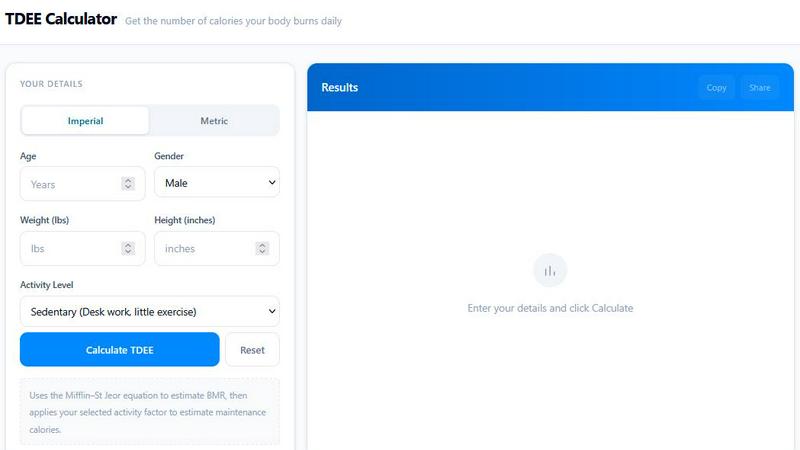
About TDEE Calculator
TDEE Calculator is a fast, accurate, and completely free online tool designed to help you estimate your Total Daily Energy Expenditure (TDEE) with confidence. By entering basic personal details such as your age, sex, height, weight, and activity level, the calculator instantly provides your maintenance calorie number and practical targets for fat loss, muscle gain, or weight maintenance. The tool is built for anyone who wants to take control of their nutrition and body composition, whether you are just starting your fitness journey or are an experienced athlete looking to fine-tune your intake. Its main value proposition lies in its simplicity and scientific rigor. TDEE Calculator uses the proven Mifflin-St Jeor equation, which research published in the American Journal of Clinical Nutrition has shown to be one of the most accurate methods for estimating resting metabolic rate in healthy adults. This means you are getting estimates based on real physiology, not guesswork. Beyond just a calorie number, the tool provides helpful insights including calorie deficit and surplus recommendations, macro guidance, and activity-based adjustments so you can create a nutrition plan that fits your lifestyle and specific goals. The interface is designed for speed and clarity, allowing you to get results in seconds and easily refine them over time using real-world results. Whether you are trying to lose weight, build muscle, or maintain your current physique, TDEE Calculator gives you a reliable and practical starting point.
Features of TDEE Calculator
Mifflin-St Jeor Equation
The calculator employs the Mifflin-St Jeor equation, a scientifically validated formula that provides highly accurate estimates of your Basal Metabolic Rate (BMR). For men, the formula is BMR = (10 x weight in kg) + (6.25 x height in cm) - (5 x age) + 5. For women, it is BMR = (10 x weight in kg) + (6.25 x height in cm) - (5 x age) - 161. This ensures your calorie estimate is rooted in proven physiological research.
Activity Level Customization
Recognizing that no two lifestyles are the same, the tool offers five distinct activity levels ranging from Sedentary (1.2) for desk workers with little exercise to Athlete (1.9) for those with multiple daily training sessions. This allows you to select the option that most closely matches your daily movement, ensuring your TDEE calculation is personalized and accurate for your specific routine.
Instant Results and Actionable Targets
After entering your details, the calculator instantly displays your maintenance calories. It goes beyond a single number by providing practical targets for calorie deficits (for fat loss) and surpluses (for muscle gain). This feature helps you understand not just what you burn, but how to adjust your intake to achieve your specific body composition goals with clear, actionable guidance.
Metric and Imperial Unit Support
The tool accommodates users worldwide by offering both Metric and Imperial unit options. You can easily switch between entering your weight in kilograms or pounds and your height in centimeters or inches. This flexibility ensures a seamless user experience regardless of your preferred measurement system, removing any barriers to getting your results quickly.
Use Cases of TDEE Calculator
Weight Loss Planning
For individuals aiming to lose weight, the TDEE Calculator provides a critical starting point by establishing your maintenance calories. You can then create a safe and effective calorie deficit, typically 250-500 calories below your TDEE, to promote consistent fat loss. The tool helps you understand the size of the energy shortfall needed to see results without resorting to extreme or unhealthy restriction, making your weight loss journey more sustainable.
Muscle Building and Bulking
Those focused on building muscle mass can use the calculator to determine a precise calorie surplus. By knowing your maintenance calories, you can add a modest surplus of approximately 200-350 calories per day to support muscle protein synthesis and recovery from training. This targeted approach helps you gain lean mass efficiently while minimizing the accumulation of excess body fat, leading to a more successful bulking phase.
Performance Optimization for Athletes
Athletes and highly active individuals can use the TDEE Calculator to ensure they are eating enough to fuel their training and recovery. Consuming too few calories for extended periods can negatively impact hormone function, recovery, and training quality. By accurately estimating their energy needs, athletes can plan their meals to support peak performance, maintain energy levels, and prevent the negative effects of under-fueling.
Maintenance and Lifestyle Management
For individuals who have reached their goal weight or simply want to maintain their current physique, the calculator offers a reliable baseline for daily calorie intake. By using the estimate consistently for 2-3 weeks and monitoring body weight, users can refine their intake to stay stable. This use case is ideal for those who want to manage their weight long-term without the constant guesswork of restrictive dieting.
Frequently Asked Questions
What does TDEE mean?
TDEE stands for Total Daily Energy Expenditure. It represents the total number of calories your body burns in a single day. This includes the energy required for basic life-sustaining functions at rest (your Basal Metabolic Rate), the energy used to digest and process food (the thermic effect of food), and the calories burned through all forms of physical activity and exercise.
How is TDEE different from BMR?
BMR, or Basal Metabolic Rate, is the number of calories your body needs at complete rest to maintain vital functions like breathing and circulation. TDEE is a broader measure that includes your BMR plus all additional energy burned through daily movement, exercise, and digestion. In short, BMR is a component of your TDEE, and your TDEE is always higher than your BMR.
How many calories should I eat to lose weight?
To lose weight, you should consume fewer calories than your TDEE. A common and sustainable starting point is to create a daily deficit of 250 to 500 calories. This typically leads to a weight loss of about 0.5 to 1 pound per week. It is important to treat your TDEE as a starting estimate and adjust based on your real-world results over a few weeks.
Should I recalculate after losing weight?
Yes, you should recalculate your TDEE after significant weight loss. As you lose weight, your body requires fewer calories to function, meaning your BMR and TDEE will decrease. Recalculating ensures your calorie targets remain accurate and effective for your new body composition. It is a good practice to reassess your numbers after every 10 to 15 pounds of weight change.
Similar to TDEE Calculator

Pawjojo is a pet health app that lets you log meals, meds, and symptoms in seconds, then turns that data into trends, early warnings, and vet-ready.

Caesura is a macOS menu-bar app that reminds you to drink water, stretch, rest your eyes, and breathe on science-backed intervals.

NoroMeal creates personalized weekly meal plans tailored to your goals, preferences, and lifestyle, eliminating guesswork from nutrition.

GetFIT App provides personalized meal plans, recipes, calorie tracking, and workout programs for effortless weight loss and muscle building.

Holly AI automates patient scheduling and front desk tasks for healthcare providers, boosting revenue and preventing staff burnout.

Droidal Insurance Verification AI Agent ensures real-time eligibility checks, reducing denials and streamlining patient data management effortlessly.

GetFIT App simplifies your fitness journey with personalized meal plans, effective workouts, and easy calorie tracking for lasting results.